Heavy Rum: what it is and how it is made
Within the world of rum there is a category that represents one of the most complex, powerful and technically interesting expressions of distillation: Heavy Rum. In this article, Javier Herrera explains exactly what it is, how it is born in fermentation and how it is preserved during distillation.
Javier Herrera, rum specialist and technical distillery adviser
1. Introduction: the most intense character in the world of rum
Within the world of rum there is a category that represents one of the most complex, powerful and technically interesting expressions of distillation: Heavy Rum.
Unlike light rums, designed to offer clean, smooth and relatively neutral profiles, Heavy Rums are characterized by a high concentration of aromatic substances coming from fermentation and preserved during distillation.
They are rums with a personality of their own, where we can find aromas of very ripe tropical fruits, banana, fermented pineapple, stone fruits, spices, vegetal notes, olives, solvents, vinegar, leather and other nuances that can be surprising for those used to conventional commercial rums.
Making them requires deep knowledge of fermentation, microbiology, the chemistry of volatile compounds and the behaviour of distillation equipment.
Jamaica is probably the territory best known for this tradition, with historic distilleries. However, heavy, highly aromatic rums are also made in other Caribbean territories, La Réunion and Africa.
At Hacienda Ocú, in Panama, this type of rum is produced with different kinds of fermentation.
To truly understand what a Heavy Rum is, you have to stop thinking only about alcohol and start studying everything that accompanies the ethanol.
2. What exactly is a Heavy Rum?
A Heavy Rum is a rum that retains a high concentration of secondary compounds or congeners, responsible for much of its aroma, flavour, texture and personality.
These compounds are generated mainly during fermentation, and their final presence depends on how distillation is carried out.
Among the main components we find:
- Esters: responsible for numerous fruity, floral and sweet aromas.
- Higher alcohols: contribute to body, structure and certain aromatic nuances.
- Organic acids: take part in ester formation and add complexity.
- Aldehydes: involved in fruity, vegetal and pungent aromatic profiles.
- Carbonyl compounds and other volatiles: contribute to the overall complexity of the distillate.
The fundamental difference between a light rum and a heavy one is not necessarily its alcoholic strength, its colour or its years of aging. It lies in the chemical composition of the distillate.
A rum can come off the still completely transparent and be extraordinarily heavy from an aromatic point of view.
An important distinction: Heavy Rum and High Ester Rum are not perfectly equivalent terms. High Ester describes especially a high concentration of esters, while Heavy Rum refers to a broader profile of congeners and an intense aromatic character.
Nor is there a single international definition setting a universal threshold for all Heavy Rums.
This distinction matters to avoid classifying any aromatically powerful rum as a High Ester simply because of its olfactory intensity.
3. Fermentation: where true Heavy Rum is born
A truly decisive phase in heavy rum production is fermentation.
Conventional light rums generally aim for a relatively clean, controlled and efficient fermentation, with the goal of converting sugars into alcohol and avoiding excessive production of secondary compounds.
In Heavy Rum production, by contrast, the aim is to develop greater chemical and aromatic complexity.
Fermentation stops being merely a process to produce alcohol and becomes a tool to design the sensory profile of the distillate.
3.1. Raw materials
The traditional raw material for many is sugar cane molasses, although at Hacienda Ocú they work with all three types of sugar cane raw material: cane juice, cane molasses and cane honey.
Sugar cane contains fermentable sugars, minerals and other components that influence the behaviour of microorganisms.
Preparing the wort requires:
- Molasses.
- Water.
- Yeasts.
- Vinasse or dunder, when it is part of the production method.
- Other acidic components or microbiological cultures, according to each distillery's tradition.
Although Jamaica is especially known for its molasses Heavy Rums, we should not think this raw material is essential. There are also highly aromatic rums made from cane juice.
3.2. The importance of fermentation time
One of the elements that distinguishes many Heavy Rums is the length of their fermentation.
While a light rum can be produced with relatively short fermentations, heavy rums may need much longer periods.
As a guide, we can find:
| Fermentation type | Indicative duration |
|---|---|
| Conventional light rum | 24-72 hours |
| Medium-profile rum | 3-5 days |
| Heavy rum | 5-10 days |
| High Ester fermentations | 10-21 days or several weeks |
These ranges are indicative, not a legal classification or a universal recipe. There are processes that fall outside them.
Why extend fermentation?
Because during that time microorganisms can generate a greater diversity of higher alcohols, organic acids, esters and other volatile compounds.
However, a long fermentation does not automatically guarantee a good heavy rum. Temperature, pH, sugar concentration, microbiological activity and acid evolution must all be controlled.
The goal is not simply to let it ferment longer, but to achieve a specific aromatic composition.
4. Distillation: how to preserve the aromas
Once fermentation is finished, one of the most decisive phases arrives: distillation.
The goal is not simply to obtain high-strength alcohol. It is about selecting which substances pass into the distillate and in what proportion.
Here we find a fundamental difference between distillation systems.
4.1. Pot Still
The batch still or Pot Still is one of the most important historic pieces of equipment for heavy rum production.
It allows batch work and preserves a significant proportion of the congeners generated during fermentation.
Traditional systems may incorporate one or two retorts, where alcoholic vapours go through further stages of contact and concentration.
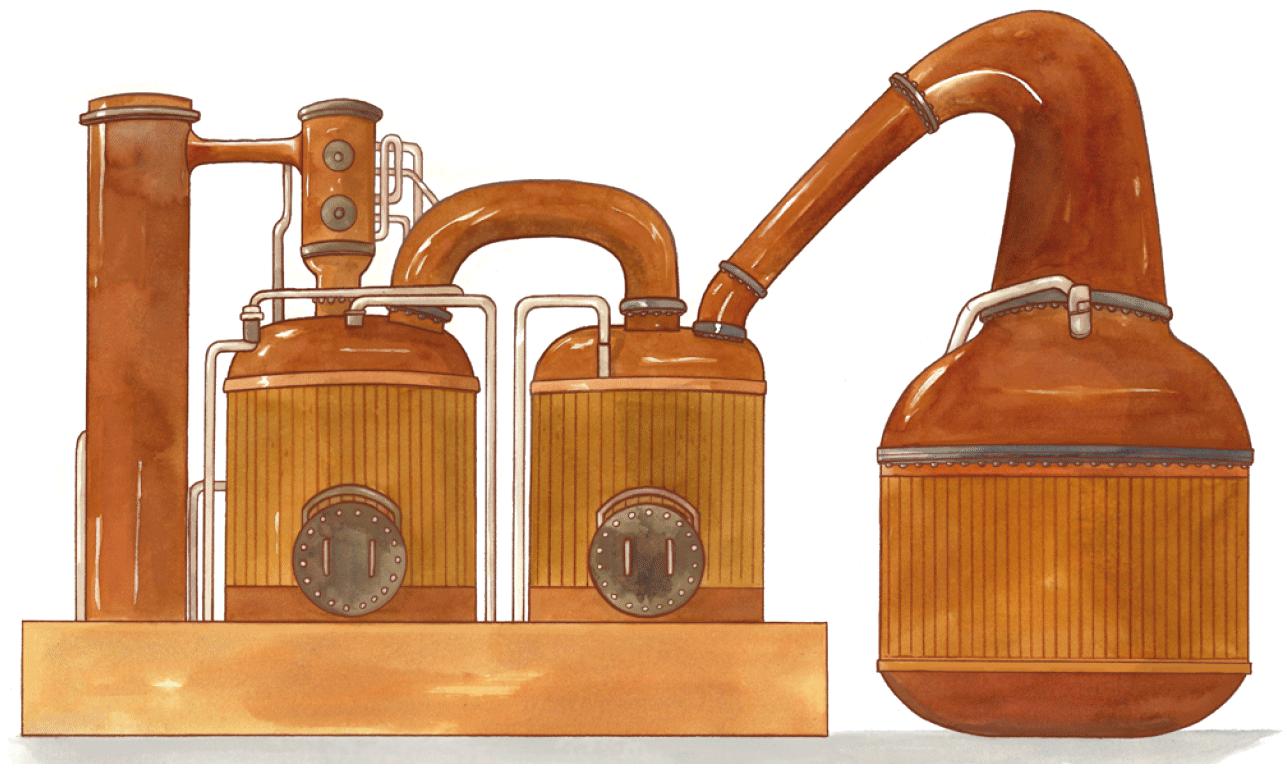
The behaviour of the still depends on multiple factors:
- Equipment geometry.
- Charge volume.
- Wash composition.
- Temperature and pressure.
- Internal reflux.
- Retort design.
- Distillation speed.
- Selection of heads, hearts and tails.
The combination of these parameters determines the character of the distillate.
A Heavy Rum is not simply a rum distilled at low strength. It is a product whose distillation process preserves a specific profile of aromatic compounds.
4.2. Column distillation
It is also possible to produce heavy rums using distillation columns.
However, a distinction must be made between a column designed to obtain high-purity alcohol and a column configured to retain a larger amount of congeners.
A distillation column does not necessarily produce light rum.
The number of plates, the reflux, the draw-off points and the operating conditions directly influence the composition of the distillate.
Single-stage or lower-rectification columns can produce aromatically very expressive distillates.
Javier Herrera
Rum specialist and technical distillery adviser.
Hacienda Ocú bulk rum supply options
Looking for a bulk rum supplier?
Contact Hacienda Ocú to discuss supply options, request samples and receive a proposal tailored to your business requirements and destination market.
Request a quote